We have full access to your customer database: 48,212 records…
Pay 12 BTC within 72 hours, or we publish everything and notify your customers.
We have full access to your customer database: 48,212 records…
Pay 12 BTC within 72 hours, or we publish everything and notify your customers.

Your first report is free.
 AppSumo
 TAAFT
Attack Surface Discovery finds every domain, service and staging box you expose, including the ones nobody remembers. AI Pentest then attacks the apps that matter the way a person would, and proves every finding before you see it. Findings, owners and alert rules live in one place, and there is nothing to install.
GET /v2/invoices/48190?expand=lines
Authorization: Bearer eyJhbGciOi… (tenant B)
HTTP/1.1 200 OK  1.8 KB · 204 ms
{ "tenant_id": "t_acme_a", "lines": [4 items] }
Replayed twice from a fresh session. Fixed in 2026.11.3 for the base route, still open on ?expand=lines.

High · PL-101 reopened by retest
PentestLynxConfidentialAn authenticated user of tenant B can read invoice lines of any other tenant by adding ?expand=lines to the invoice route.
| Severity | High (8.1) |
| Status | Reopened 24 Nov |
| Owner | Tom R. |
Page 14 of 42
EU-hosted. All pentest data is hosted in the EU and never leaves the EU. GDPR compliant by design.
From the first request to the signed letter, everything happens in one workspace.
Your risk trend, open findings by severity and every fix we verified, on one screen.
Acme Payments · app.example.com and api.example.com
Replayed the original exploit: the API now returns 401.
The role field is ignored on PATCH /v2/users/me.
Payload is now encoded in the results page.
Retest: ?expand=lines still returns another tenant's data.
Proof and fix attached, assigned to Tom R.
Watch the agents form hypotheses, attack and replay, with a kill switch one click away.
Retest of Run #3 plus release 2026.11.3 · 4 hosts · window ends 20:00 CET
| Agent | Status | Working on |
|---|---|---|
| Recon | Done | |
| Mapping | Done | |
| Access control | Attacking | |
| Auth and session | Attacking | |
| Injection | Attacking | |
| Business logic | Attacking | |
| Confirm | Replaying |
See how small findings chain into a breach, and which fix breaks the chain.
Three findings that are medium or high alone chain into full customer data exposure, with no account needed.
An attacker with no account reads a browser key from the public bundle, lists every tenant through the admin API, then pulls invoice lines for any tenant.
Require staff SSO, not a static key. Breaks the chain alone.
Rotate it and serve from the backend.
Same check on every invoice query path.
Every finding is exploited and replayed before it reaches this list.
14 from Run #3 · each one exploited and replayed before it was reported
Proof, a curl to reproduce it, CVSS 3.1 and the code fix, in one place.
GET /v2/invoices/48190?expand=lines HTTP/1.1
Host: api.example.com
Authorization: Bearer eyJhbGciOi…
# token belongs to tenant B
X-Request-Id: pl-r4-7f3a91
Accept: application/json
HTTP/1.1 200 OK
{ "id": 48190,
  "tenant_id": "t_acme_a",
  "customer": Jane Example,
  "email": j.example@mail.test,
  "card_last4": 4242,
  "lines": [ 4 items ] }
curl -s 'https://api.example.com/v2/invoices/48190?expand=lines' \
  -H "Authorization: Bearer $TENANT_B_TOKEN" | jq '.tenant_id'   # prints "t_acme_a"
Base route checks tenant_id since 2026.11.3.
The expand path uses a second query without the check. Diff above covers both.
A senior pentester signs a letter your auditor can map to SOC 2, ISO 27001 and PCI DSS.
Human review by a senior pentester of every finding, the evidence and the retest
PentestLynx performed an authenticated penetration test of the Acme Payments web application and API between 17 and 18 November 2026, with a retest of fixed findings on 20 November 2026. Testing was authorised in writing by the client and limited to the scope below.
Product screens show the PentestLynx workspace. Sample data.
Recon, exploitation, proof, fixes, reports and sign-off.
Our AI Pentest agents map your app first: every route, role and parameter. Then they form hypotheses the way a human tester does, try them, and replay each hit twice before they call it a finding. Every step is explained in how it works, and it pays off most after a big release.
412 endpoints · 3 roles · 2 tenants mapped
1,286 hypotheses tried · 3 queued to confirm
Personal data is redacted in the evidence we keep.
Each finding has the exact request and response that proved it, a CVSS 3.1 score and a code-level fix for your stack. One click turns it into a Jira or Linear issue with all of that attached, so nobody rewrites the report into tickets. Retests replay the original exploit, so fixed means fixed. That is how every AI Pentest report works.
A scanner does not know that a Viewer must never see another tenant's invoices. We sign in as every role you give us and try each endpoint as each of them, across tenants. That is where the expensive bugs live: business logic and broken access control in your REST and GraphQL APIs. Building with AI coding tools? Start with AI-built apps.
| Endpoint | Admin | Member | Viewer |
|---|---|---|---|
| GET /v2/invoices/{id} | |||
| PATCH /v2/users/{id}/role | |||
| POST /v2/refunds | |||
| GET /v2/exports/{id} | |||
| DELETE /v2/webhooks/{id} |
Click a cell to see the request we sent and what came back.
Attack Surface Discovery reads DNS, certificate logs and your JavaScript to list every host you expose. New hosts are flagged the day they appear, and risky ones (an open admin panel, a staging API, an old TLS version) go to the top. You decide what goes into scope.
A senior pentester reviews every finding and the retest, then signs an attestation letter with the scope, dates, method and result, mapped to the controls your framework asks for. It is built for a compliance pentest, the SOC 2, ISO 27001 or PCI DSS audit that needs one, and the enterprise deal waiting on it.
PentestLynxPL-ATT-2026-0412You set the rate limit, the test window and the paths we must never touch. Traffic comes from two fixed IP addresses you can allowlist, and every request we send is logged. One switch stops every agent at once. The trust center has the details.
Find forgotten assets
Subdomains, exposed files, leaked keys and outdated software, mapped before the agents attack.
02Agents that break in
03REST and GraphQL, BOLA
04Flaws scanners can't see
05JWT, resets, MFA
06Keys leaked in JS
07Open buckets and panels
08SPF, DKIM, DMARC
09No exploit, no finding
Every finding is replayed from a clean session before it reaches your report.
10CVSS 3.1 plus proof
11Code-level fixes
12SOC 2, ISO 27001, PCI DSS
13Check before you buy
14Early access
A sample report on a test app. Every finding comes with its location, proof and fix.
app.example.com, sample report, 7 findings
 For engineering leads
Every finding comes with the request that proves it and a code-level fix for your stack. Export it to Jira or Linear and it lands in the sprint, not in a PDF nobody opens.
Testing after a big release For security teams
Each finding is exploited before it is reported, deduplicated, and shipped with the full request log. Scope limits and safety controls keep the test on the targets you approved.
Testing AI-built apps For founders and CISOs
One report you can hand to an enterprise buyer, map to your audit controls and attach to an insurance form. Add a human sign-off when the buyer asks for a named pentester.
Closing an enterprise dealNo new dashboard to babysit. Findings go to the tools you already use, and we only ping you when it matters.
Explore integrations Webhooks
 Bitbucket
 Linear
 Jira
 Slack
 GitHub
 Vanta
 Docker Hub
 Cloudflare
 Microsoft Teams
 Claude
 Cursor
 GitLab
 JetBrains
 Secureframe
 AWS
 Lovable
 Drata
 VS Code
 Azure DevOpsWebhooksBitbucketLinearJiraSlackGitHubVantaDocker HubCloudflareMicrosoft TeamsClaudeCursorGitLabJetBrainsSecureframeAWSLovableDrataVS CodeAzure DevOps

The buyer's security team wants a recent pentest before they sign. Send them a signed letter and a clean summary instead of a promise, and answer the questionnaire with evidence.
SOC 2, ISO 27001 and PCI DSS auditors want proof that you test for vulnerabilities and fix them. The human sign-off gives them a report and a letter signed by a senior pentester.
Insurers ask whether you had a recent penetration test and what you fixed. A dated report and attestation letter answer that in one attachment.
Investors and acquirers ask about security risk in the data room. Show what was tested, what was found and what is already fixed.
A rewrite, a new API or a new pricing flow changes your attack surface overnight. Test the paths that changed before an attacker finds them.
Apps built fast with AI coding tools often ship with missing access checks and keys in the frontend. Find out what the code assistant left open.
Before you connect a vendor to your data, test their app with their written consent. You see real findings, not a self-assessment.
From each company's own public pages. Where we found nothing, the cell says so. Where they are stronger, we say that too.
| Compared on | PentestLynx | Manual pentest firm | Vulnerability scanner | XBOW | Intruder | Aikido |
|---|---|---|---|---|---|---|
| Proves each finding is exploitable | Yes, every finding is replayed from a clean session | Not published | Not published | Yes, "every finding is a working exploit"xbow.com | Not published | Yes, unproven findings are droppedAikido, AI pentest |
| Business logic | Yes, agents test your rules: prices, coupons, workflows | Yes, manual testingInvicti | Rarely; needs human reasoningInvicti | Not published | Not published | Yes, named in its test classesAikido, AI pentest |
| Time to first findings | Hours, not weeks | 4 to 7 weeks to startEdgescan | Same day, self-servePortSwigger | First results in hoursxbow.com | Same-day pentestIntruder, AI pentesting | Report in a few hoursAikido, AI pentest |
| Human sign-off for auditors | Yes, a senior pentester signs the letter | Not published | Not published | No; its compare page says pentest services win on a named signatoryXBOW, Compare | Auditor-accepted report, or a full refundIntruder, Pentest pricing | Letter of attestation; CREST accreditedAikido, AI pentest |
| EU-hosted AI | Yes, open-weight models hosted in the EU | Not published | Not published | Data residency options, EU includedXBOW, Guardrails | Not published | DPA, plus an on-prem appliance optionAikido, AI pentest |
| Authenticated, multi-role testing | Yes, with test accounts for each role | Not published | Not published | Not published | Authenticated scanning (DAST)intruder.io | Yes, roles and cross-tenant access in scopeAikido, AI pentest |
| Price model | Per report | Per engagementAstra | SubscriptionPortSwigger | Usage-based, scoped to youXBOW, Pricing | Fixed price per pentestIntruder, Pentest pricing | Per pentest, auto-scopedAikido, AI pentest |
| Best for | Teams that need proof fast and a letter for auditors | Hardening reviews; humans beat AI here in one benchmarkAikido benchmark | Frequent checks for known issuesInvicti | Large app estates and security teamsxbow.com | One platform for scanning, cloud and pentestsintruder.io | Developer teams wanting code-to-cloud securityaikido.dev |

Our agents run on open-weight models hosted in the EU. Your data never goes to a third-party AI provider and never trains any model. We keep only the redacted evidence your report needs, and delete it when you ask.
Audit-ready reports, signed by certified pentesters, accepted by the highest compliance standards.
 ISO/IEC 27001
 PCI DSS 4.0.1
 SOC 2
 GDPR
 HIPAA
 NIST SP 800-115
 DORA
 NIS2
 OWASP
 CVSS 3.1
 PTES
 CWE-mapped
 OSCP · OSWE
 CREST
 EU-hosted AI
AI finds and proves the bugs. A senior pentester signs the letter.
Four senior pentesters with 15+ years in the industry, protecting Fortune 500 companies and many smaller businesses. We break into web apps and APIs, review source code and write advanced exploits.
Scanners match known signatures. Our AI agents sign in, chain steps and try real attacks the way a human tester would, and a finding only counts once its exploit is replayed and confirmed.
Yes. It is a light AI pass that never breaks in and names a few real issues. The detailed report and the human sign-off are on the pricing page.
No. We test only the domain you verified, rate-limit every request, never send destructive payloads and can stop every agent at once.
Use the human sign-off. A senior pentester reviews the findings, re-tests the critical paths and signs a letter your auditor can file.
The four senior pentesters described above, with 15+ years in the industry. One of them reviews and signs every sign-off.
Only the redacted evidence your report needs, hosted in the EU. Our models never train on it, and we delete it when you ask.

Free report, no card needed.
15-minute call
A 15-minute call about your app, your deadline and what your auditor, insurer or customer needs to see.

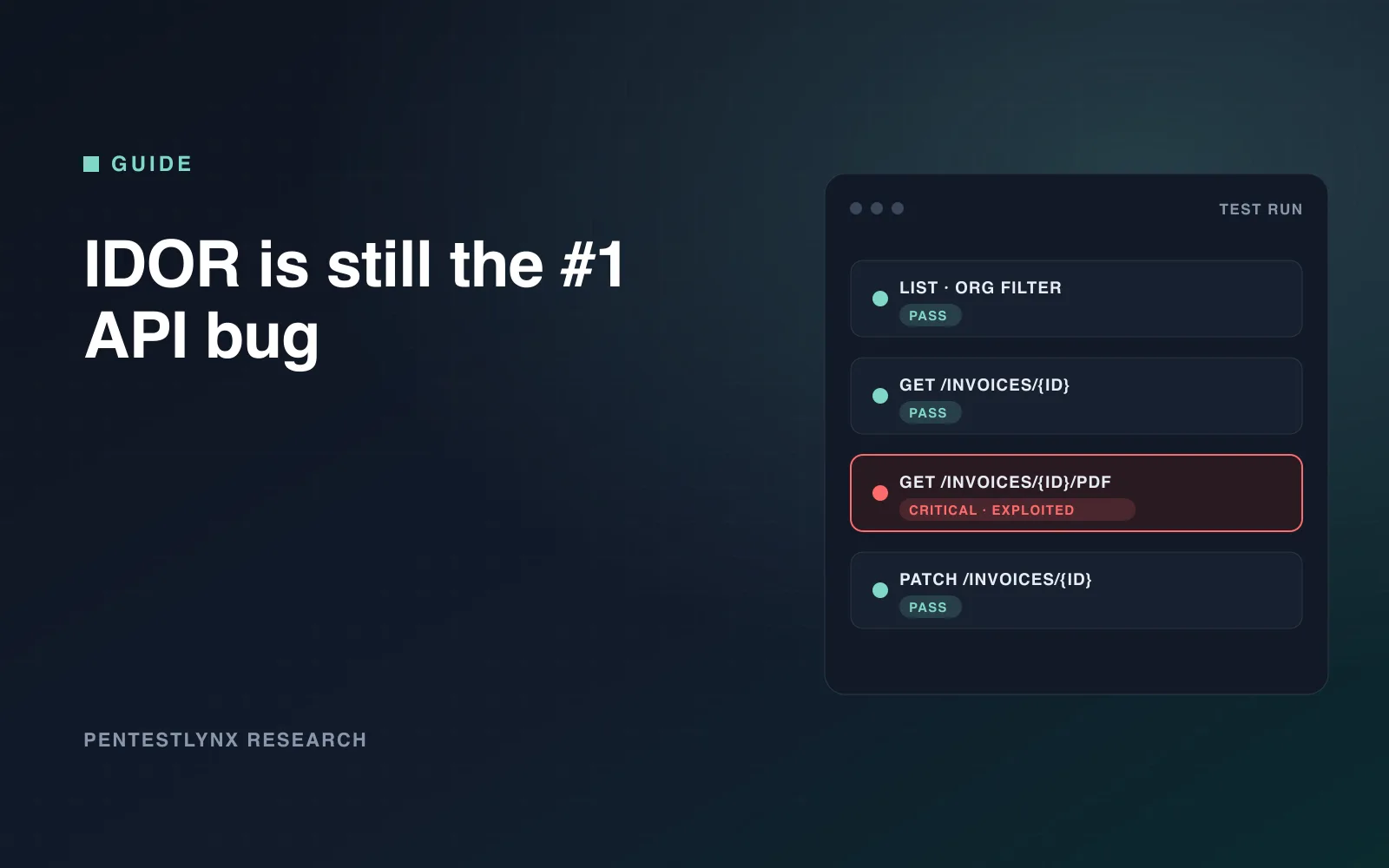

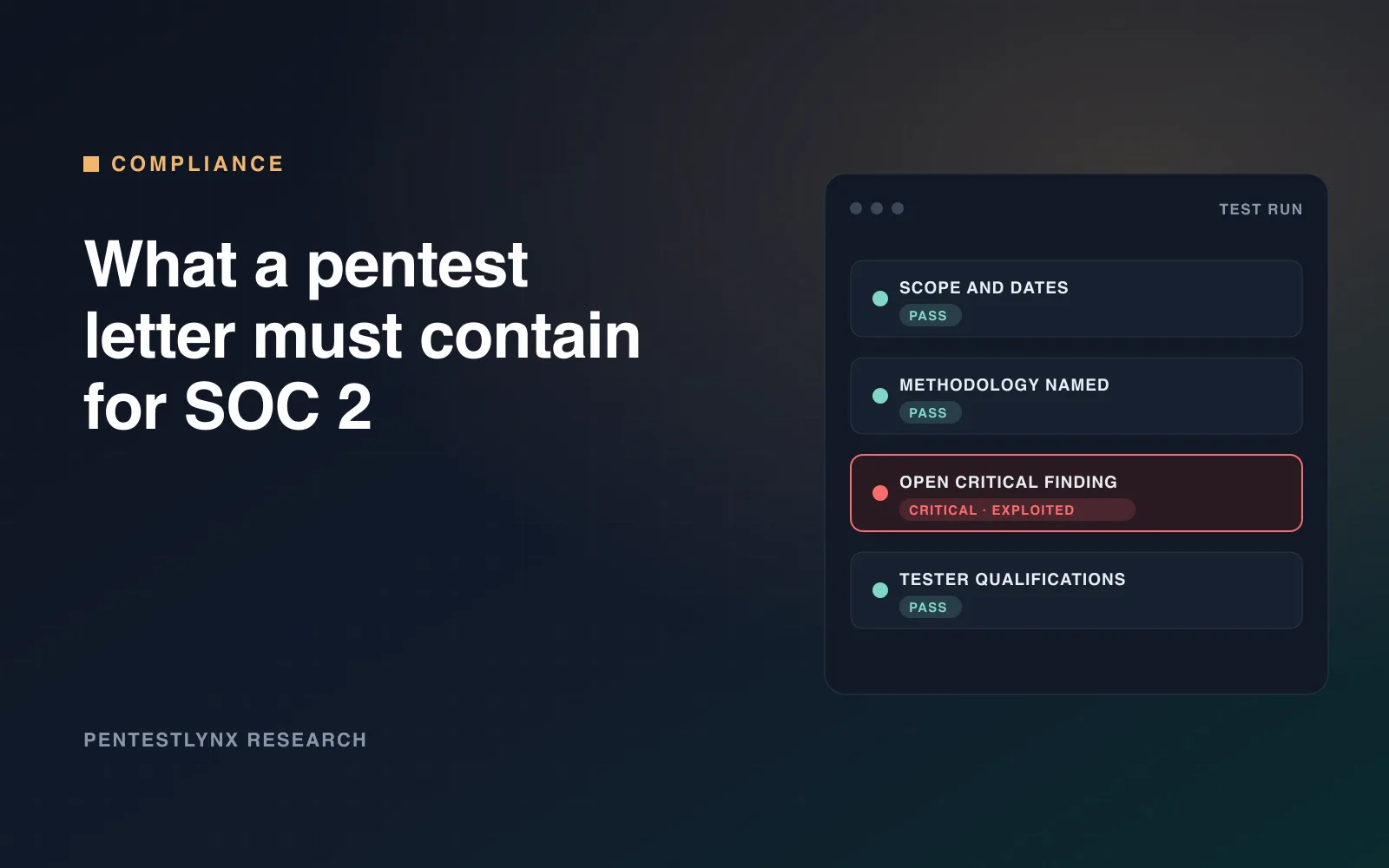



The expand path runs a second query without the tenant check. The suggested diff covers both.